
Drone entrepreneurs
Drone entrepreneurs are always thinking how to fly the business as well as the aircraft. There are many ways to approach it, but most drone businesses go through several stages, and encounter different challenges along the way. Understanding the natural evolution empowers making the necessary strategic decisions.

Evolution of a drone business
There are five typical patterns of growth:
- Passion
- Incorporation
- Focus
- Scale
- Diversification
Level 1, Passion. The passion phase is the green field where the imagination runs free. This is where the entrepreneur builds the necessary knowledge and skills to run his business. This might include market research, talking to companies and individuals, private research, formal training, acquisition of test equipment, and flying. If the business is a smaller business, this is where the entrepreneur enrolls in-flight school to acquire the training to operate the drone and receive any required individual credentials or licensing.
Level 2, Incorporation. There are different variants of this stage, and sometimes it may precede or co-develop with the passion stage, but at some point, the entrepreneur decides to start doing business. Some company structure is needed. Not every entrepreneur formally incorporates, but it is common these days. Regardless, some business structure is needed, even if the entrepreneur initially pursues opportunistic gigs. This structure is what separates the entrepreneur from the hobbyist. This may be the final destination for some small or sole proprietor businesses such as photography.
Level 3, Strategic Focus. Here is where business acumen begins to drive drive passion. Not all drone missions are the same. And they don’t all pay the same either. The entrepreneur puts passion in the back seat and lets strategy drive. After careful assessment of the business opportunities, he chooses the domain that maximizes revenue potential and puts the weight of his energy in this direction. Focusing the limited resources of the new company in the domain that allows the highest margins, the business develops the necessary competence to excel in the chosen domain.
Level 4, Scale. Once level 3 competence has been achieved, the focus shifts to execution. Here, the entrepreneur focuses on winning recurring contracts as well as winning new accounts. The company resources evolve to handle the increased volume. Revenue steadily increases along with it.
Level 5, Diversification. Transition to this level is necessary when market resistance is encountered in the chosen domain. This could either come from opportunity constraints or competition. To continue to grow, the business must expand its service offering. The purpose is to increase the market or margins within a market to propel the revenues forward. This might be expanding in new domains, or it may also be simply expanding the offerings within a domain to tap new fees.
Selective pressure
Selective pressure in your business evolution is any external environmental factor that influences the business’ chances of survival and growth. In nature, selective pressures can include predators, competition for resources, disease, climate, habitat changes, or mating preferences. For your business, they are similar. Competitors can prey on your customers and compete for resources. Business climate, organizational health, these too determine if your company survives. Entrepreneurs possessing traits that improve their ability to cope with these pressures are more likely to survive and leave strong companies for future generations.
Analysis of drone business evolution reveals a number of selective pressures facing entrepreneurs. Any strategy may require the concern to traverse fitness valleys. Understanding these pressures help identify strategies for successfully crossing these valleys to emerge as a better business on the other side.
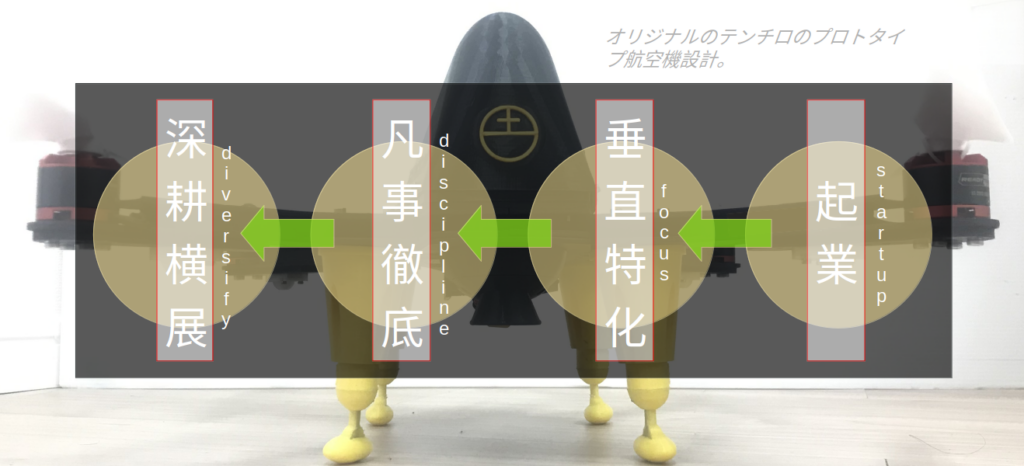
Here are the challenges that face a company as it evolves. After startup, the business is faced with its first challenge of focus, focus on the target high-margin domain that propels business from startup gigs to a a service leader. Focus, tools, skills, and margins are the capacity that must be developed. This capacity becomes that foundation when developed with discipline allows the business to scale. Finally, competitive differentiation is secured through diversification into sub domains that complete the customer solution. In these transitions, two patterns emerge.
Valley of Knowledge. From the very first transition, the business encounters the organizational fitness Valley of Knowledge. It starts early and continues to be a selective pressure through levels 1, 3, and 5 with some reprieve in stages 2 and 3.
Valley of Costs. Where capacity development precedes business, the gap between revenue and costs creates a fitness valley the organization must transit to successfully emerge in a strong market position. The valley of costs also manifests primarily in levels 1, 3 and 5, but can be most inhibiting in level 3. It can also appear in level 4, if scaling strategy is not considered in choices made in level 3.
Tripartite selective regime
There is a three-part selective regime that appears in the third level that can particularly complicate evolution of small drone operations from level 2 to level 3 without substantial outside capital. While other minor pressures arise in evels 1 and 2, most entrepreneurs can navigate these. The pressures in level 3 are most likely to become a glass wall for a large number of entrepreneurs without heavy capitalization. Three barriers converge here:
- Revenues. At this level, the company has not yet acquired the capacity to achieve high-margin revenues from the target domain. If there are any revenues at all, these come from gigs for which the company has built competence in levels 1 and 2.
- Tool costs. Domain specific solutions are going to require specialized hardware and software capabilities. These must be acquired before any business can be secured. In some cases, the company may be lucky enough to secure contracts before the investment. However, it is likely that at least some of the expense must be outlaid before there is enough business.
- Skill proficiency. The purpose of this level is to develop competence with the specific tools to confidently pursue the target high-margin domain. Therefore, on entry the competence is not developed. On exit, it is demonstrated in customer projects.
The revenue and tool costs taken together identify a capital barrier. With sufficient capital, the difficulty achieving this level is significantly reduced. Tools are acquired in advance, skills developed, then revenue follows. However, if the capital is not readily available, then the company must become more creative. Without the tools, skill proficiency cannot be developed. And without that, revenue stays low-margin.
Success partnership
Every stage of business evolution requires new capabilities. The challenge is that capabilities must often be developed before they can generate revenue. This creates the organizational fitness valleys where knowledge, tools, and capital requirements temporarily exceed business capacity.
Tenchiro reduces these barriers.
By providing access to domain-specific tools, operational workflows, and pricing models that scale with business maturity, Tenchiro lowers the cost of capability development while accelerating the path to proficiency. Entrepreneurs can focus on building competence and customer relationships rather than carrying the full burden of infrastructure investment.
The result is a smoother transition through the critical growth stages that separate sustainable businesses from stalled ventures.